From plastic to timber, a common thread

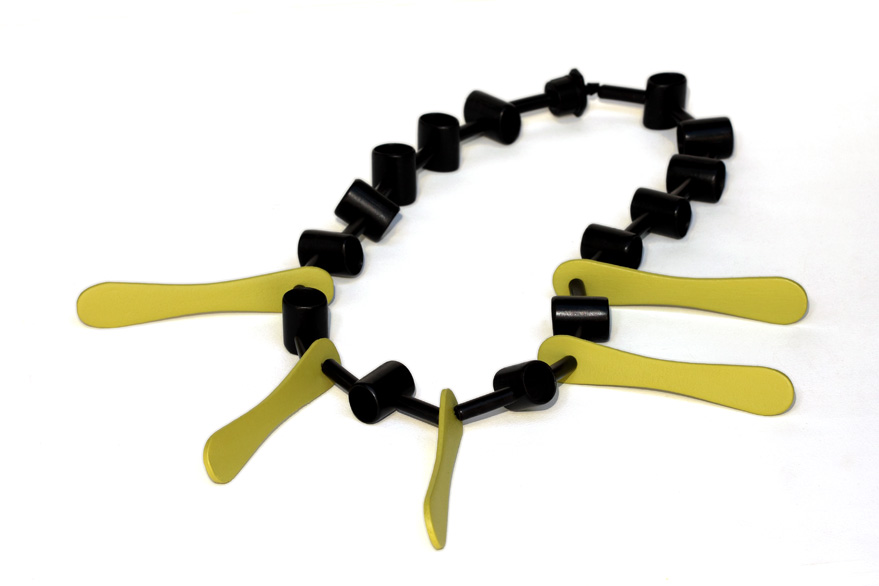
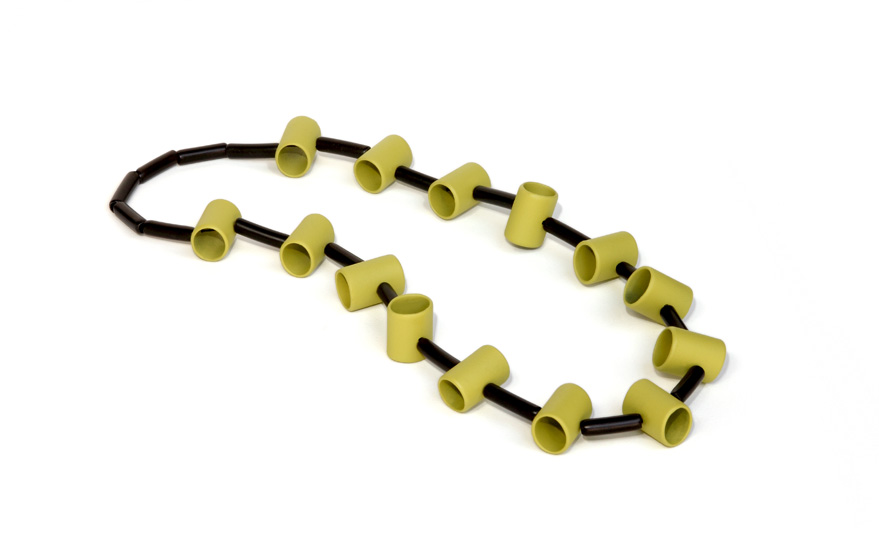
Suburban Tribal, neckpiece. Upcycled plastic pipe & conduit, paint, thread. © Blandine Hallé 2015

“Art has a privileged status in the production of symbols of national identity.” 1999, ABC & NGV (1)

From plastic to timber, there doesn’t seem to be anything in common between these two materials, yet when I use them in making my jewellery pieces, I see an underlying thread that connects them: they both express my Australian identity. These two very different, opposed materials embody the two different, opposed aspects of the Australian landscape, two signifiers of national identity (2): the urban one and the other one – the bush – a term culturally understood in Australia to be any environment that is sparsely populated or uninhabited (3).

The urban landscape could be seen as the most important element to define my Australian identity if we consider that like most Australians I live in the great suburban sprawl that surrounds the cities(4). Yet the bush has a predominant place in my psyche as an Australian. The bush has been the foundation of a distinctive Australian culture, especially as expressed in Australian literature, painting and popular music. The bush is considered to form the national character and ethos of Australians (4).

I was born and grew up in Paris and in the Alps. I made my first trip to Australia in 1994 and immediately fell under the fascinating power of the bush. As Australian painter Russell Drysdale so well says it:

“It is an environment which I love and which I like to go back to, and for me it has a tremendous appeal, it is continually exciting, these curious and strange rhythms which one discovers in a vast landscape, the juxtaposition of figures, of objects, all these things are exciting. Add to that again the peculiarity of the particular land in which we live here, and you get a quality of strangeness that you do not find, I think, anywhere else. This is very ancient land, and its forms and its general psychology are so intriguing as compared to the other countries of the world that it in itself is surprising.” (5)

The Native, detail of necklace, sterling silver, linen thread. © Blandine Hallé 2015
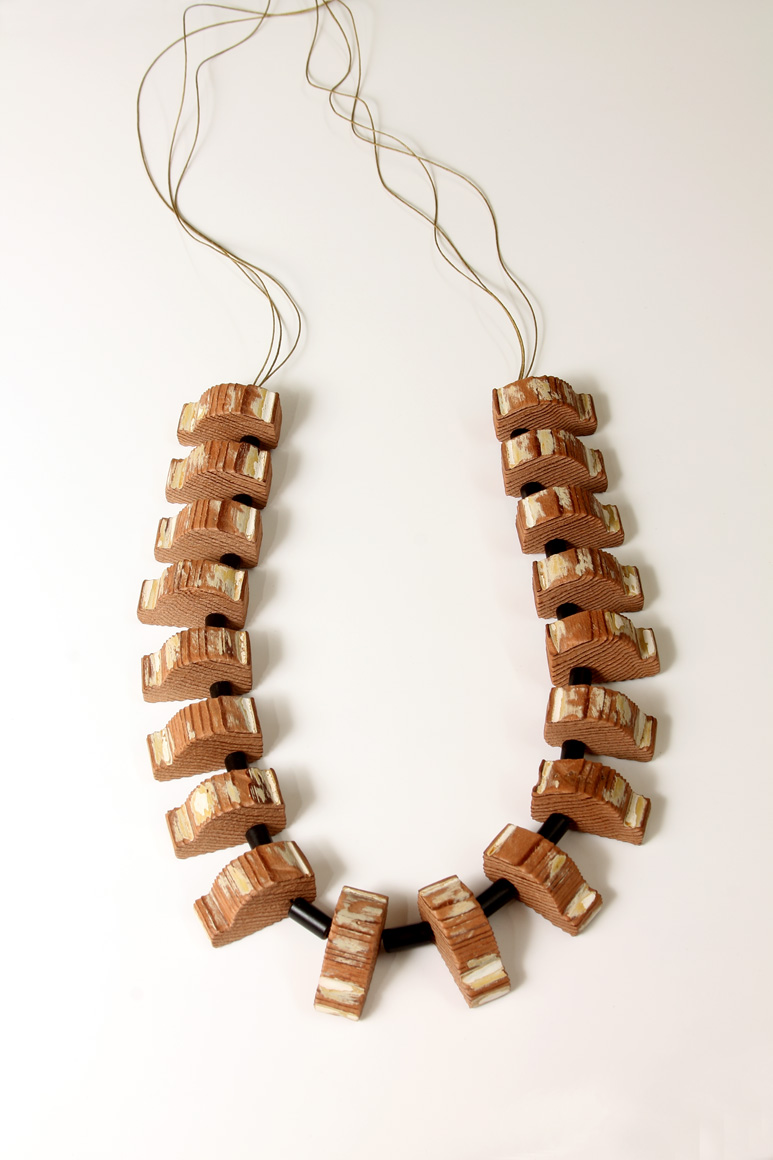
The Native, detail of necklace. Marri timber, sterling silver, linen thread. © Blandine Hallé 2015

Living in Western Australia I take part in the contemporary and materialistic life in the suburbs that I describe in my Suburban Tribal series. But my sense of belonging to Australia is not limited to my experience of living in a city. I feel also strongly connected to and care for the land and its fragile ecosystem. I have a deep respect for the Aboriginal people and their culture. That is the other side of my Australian identity, the one I express with wood and other natural materials. I feel inspired by the way the Aboriginal people “traditionally have had a spiritual and nurturing relationship with the bush, seeing themselves as belonging to the landscape, intrinsically woven into its every fibre (Head 2000; Pascoe 2007; Read 2000).” (3)
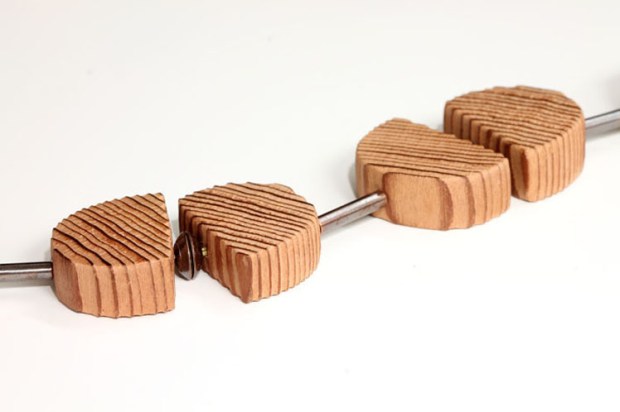
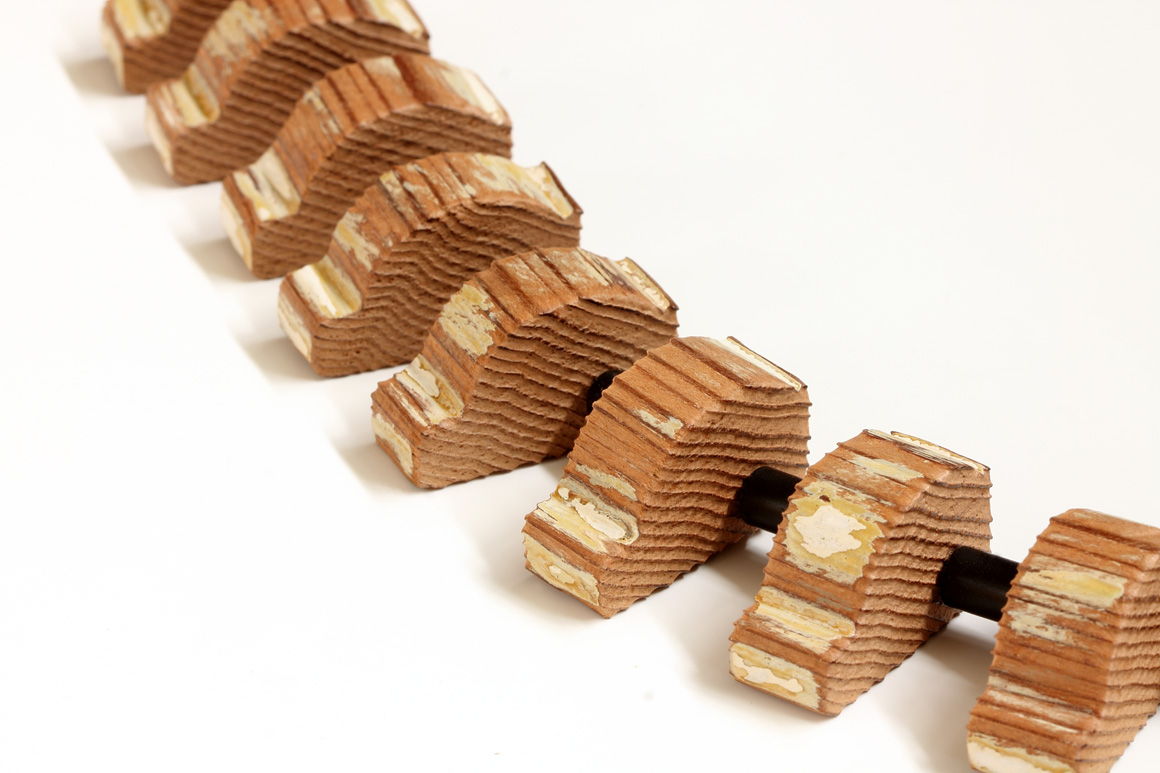
The Migrant, detail of necklace. Upcycled Baltic pine, copper, linen thread. © Blandine Hallé 2015

I see my jewellery as being my commentary on my experience as a migrant in Australia, as in my last creations, “The Native” and “The Migrant” necklaces. Today I find myself very much in the position described by D.J. Finley:

“The Australian artist must always look in two directions, physically as well as aesthetically. First, he casts a backward glance over his shoulder at what Europe is doing, then he glances quickly around at his own landscape to see what it is that makes it different from the landscape of other countries. He looks away again to see whether there is anything he can learn from the works of the old masters or the young imponderables. Again a longer look at the world around him; he must paint what he sees, feels, thinks, or dreams, and he must live. And then again he looks abroad to see whether there is a market for his work in the wider and more populous world of Europe and America.”(6)

  1. ABC and NVG collaboration, 1999, “Russell Drysdale, Introduction”. Accessed online 12/09/2015 http://www.abc.net.au/arts/drysdale/themes/intro.htm
  2. Federation University Australia, ‘Pilar Mata Dupont, Guirguis New Art Prize 2015’, accessed online 12/09/2015: http://federation.edu.au/faculties-and-schools/faculty-of-education-and-arts/post-office-gallery/guirguis-new-art-prize-gnap/2015/pilar-mata-dupont-wa
  3. Penn, ‘The Influence of the Bush on European-Australian Identity in Australian children’s literature’, The Looking Glass: new perspectives on children’s literature, Volume 11, Issue 3, 2007. Accessed online 12/09/2015: http://www.lib.latrobe.edu.au/ojs/index.php/tlg/article/view/9/9
  4. Baker, ’Contemporary Australia. 5. Sydney or the bush?’. National Centre for Australian Studies, Monash University, 2005. Accessed online 12/09/2015: http://www.abc.net.au/ra/australia/pdf/sydney_bush.pdf
  5. Drysdale interview with Hazel de Berg, February 1960, quoted in The Reserve Bank of Australia Collection, 1992, p.34. Accessible online 12/09/2015 http://www.abc.net.au/arts/drysdale/beyond/literate.htm#cw
  6. J. Finley, ‘Art in Australia: Looking both ways’, Journal of the Royal Society of Arts, London, 21 June 1957, pp. 612-13. Accessed online 12/09/2015 http://www.abc.net.au/arts/drysdale/themes/intro.htm

Du plastique au bois, un lien commun

“L’art a le statut privilégié de produire des symboles d’identité nationale” 1999, ABC & NGV (1)

Du plastique au bois, il semble qu’il n’y ait rien de commun entre ces deux matériaux, et pourtant quand je les utilise pour fabriquer mes bijoux, je vois un lien qui les relie : ils expriment tous les deux mon identité australienne. Ces deux matériaux très différents, opposés, personnalisent deux aspects différents et opposés du paysage australien, deux  signifiants de l’identité nationale  (2) : l’urbain et l’autre – le « bush » – un terme culturellement compris en Australie comme étant un environnement qui est peu peuplé ou inhabité (3).

Le paysage urbain pourrait apparaitre comme l’élément le plus important qui définit mon identité australienne si l’on considère que, comme la plupart des australiens, je vis dans la grande étendue de banlieue qui entoure les villes (4). Pourtant le « bush » » a un place prédominante dans mon psyché en tant qu’australienne. Le « bush » a été la base d’une culture australienne distincte et particulière telle qu’elle est exprimée dans la littérature, la peinture et la musique populaire australienne. Le « bush » est considéré comme formant le caractère national et l’ethos australien (4).

Je suis née et j’ai grandi à Paris et dans les Alpes. J’ai fait mon premier voyage en Australie en 1994 et je suis immédiatement tombée sous le pouvoir fascinant du bush. Comme le dit si bien le peintre australien Russell Drysdale :

« C’est un environnement que j’aime et ou j’aime retourner, qui a pour moi un attrait énorme, qui est continuellement passionnant, ces rythmes curieux et étranges que l’on découvre dans le vaste paysage, la juxtaposition des formes, des objets, toutes ces choses sont très passionnantes. Ajoutez à cela en plus la particularité de ce pays même où nous vivons, et vous avez une qualité d’étrangeté que vous ne trouvez pas, je crois, nulle part ailleurs. C’est une terre très ancienne, et sa forme et sa psychologie sont si intrigantes comparées à celles d’autres pays dans le monde que cela n’est pas en soit surprenant. » (5)

Habitant en Australie Occidentale je prends part à la vie contemporaine et matérialiste dans les banlieues telle que je la décris dans ma série Suburban Tribal. Mais mon sens d’appartenance à l’Australie n’est pas limité à mon expérience de vivre dans une ville. Je me sens également très connectée à la terre et son écosystème fragile. J’ai un profond respect pour les peuples aborigènes et leur culture. C’est l’autre aspect de mon identité australienne, celle que j’exprime avec du bois et d’autres matières naturelles. Je me sens inspirée par la façon dont les peuples aborigènes ont traditionnellement une relation spirituelle et nourrissante avec le bush, se voyant comme appartenant au paysage, tissés intrinsèquement dans sa fibre même (Head, 2000 ; Pascoe 2007 ; Read 2000). » (3)

Je vois mes bijoux comme un commentaire sur mon expérience de migrant en Australie, comme dans mes créations récentes avec les colliers « Le Natif» et « Le Migrant ». Aujourd’hui je me trouve tout à fait dans la position décrite par D.J. Finley :

« L’artiste australien doit toujours regarder dans deux directions, physiquement ainsi qu’esthétiquement. En premier il jette un regard en arrière au-dessus de son épaule pour voir ce que l’Europe fait, puis il regarde rapidement autour de lui son propre paysage pour voir ce qui le différencie des paysages des autres pays. Il regarde de nouveau ailleurs pour voir si il y a quelque chose qu’il peut apprendre du travail des anciens maitres ou des jeunes difficiles à catégoriser. De nouveau un long regard sur le monde autour de lui ; il doit peindre ce qu’il voit, ressens, penses, ou rêve, et il doit vivre. Et de nouveau un regard à l’étranger pour voir si il y a un marché pour son travail dans le monde plus grand et plus peuplé de l’Europe et de l’Amérique » (6).
Selected for Contemporary Wearables ’15

Suburban Tribal, neckpiece closeup. Repurposed plastic tube & conduit, paint, thread. © Blandine Hallé 2015
Suburban Tribal, neckpiece closeup. Upcycled plastic tube & conduit, paint, thread. © Blandine Hallé 20

I am very happy to see my neckpiece of the Suburban Tribal series selected for The Contemporary Wearables Biennial Jewellery Award and Exhibition 2015 (see Gallery Jewellery for more images) . This show invites prominent and emerging jewellers from Australia and New Zealand to show their work in Toowoomba (QLD) and, as part of a possible touring exhibition, other Australian galleries. Award winners and acquisitions will be announced at the official opening and awards ceremony on Sunday 20 September 2015 at 2pm.

Artist Statement:

This neckpiece “Suburban Tribal” is made of discarded materials collected on building sites. It is a satirical view on what has become of the Dreaming in contemporary materialistic Australia, and the loss of its original indigenous significance.

A tribal society is a group of people occupying contiguous territories and having a feeling of unity deriving from similarities in a culture, frequent contacts and a certain community of interests. In such society, apart from body beautification and adornment, jewellery is also used for rituals and to honour deities.

I associate living in Western Australian suburbs with a form of tribal society life where we have placed the house, the car and other objects on an altar that we worship in pagan rituals. We define our place in society by the possession and value of those objects.

Traditionally in tribal society, jewellery is made with products that are easily available for the people; usually the raw materials are humble. Perth’s urban sprawl landscape is full of building sites and skips; the plastic tubing and conduit I re-used are not precious materials.

Contemporary Wearables 15_invitation

Je suis très heureuse de voir le collier de ma série Suburban Tribal (traduction : Tribal de Banlieue, voir plus d’images dans la galerie bijoux) sélectionné pour l’exposition biennale du bijou contemporain « Contemporary Wearables 2015 ». Ce show invite des bijoutiers proéminents et émergeants d’Australie et de Nouvelle Zélande à présenter leur travail à Toowoomba (état du Queensland). Cette exposition pourra voyager dans d’autres galeries en Australie. Les gagnants des prix et les acquisitions seront annoncés lors de l’inauguration le dimanche 20 septembre.

Message d’artiste :

Ce collier « Suburban Tribal » est fait à partir de déchets  de matériaux de construction que j’ai récupérés. Il exprime une vue satirique de ce qu’est devenue le “Rêve” dans l’Australie matérialiste contemporaine et la perte de sa signification originelle dans la culture aborigène.

Une société tribale est un groupe de gens qui habitent des territoires voisins et qui ont un sentiment d’unité grâce à une culture commune, des centres d’intérêts partagés et de fréquents contacts. Dans une telle société les bijoux sont utilisés non seulement pour embellir et décorer le corps, mais aussi pour des rituels et pour honorer les dieux.

J’associe la vie dans les banlieues de l’Australie Occidentale avec la vie dans une forme de société tribale où nous avons élevé le rang de la maison, de la voiture, et d’autres objets au point de les mettre sur un autel pour des rituels de culte païen. Nous définissons notre place dans la société par la possession et la valeur de ces objets.

Dans une société tribale traditionnelle les bijoux sont fait de matériaux qui sont facilement disponibles, en général des matières premières humbles. Le paysage de l’étalement urbain de Perth est rempli de sites de construction et ses bennes à ordures ; le conduit et le tube en plastique que j’ai utilisés ne sont pas des matériaux précieux.

In Transit exhibition

in transit invite

Three pieces of jewellery of my serie Suburban Tribal will be presented  from 7 to 17 July  at the In Transit exhibition  in Sydney in conjunction with the JMGA biennale conference EdgesBordersGaps

Opening Saturday 11 July, 4 to 6pm. Depot II gallery,                               2 Danks Street, Waterloo, NSW

Trois bijoux de ma série Tribu de Banlieue seront présentés du 7 au 17 juillet à l’exposition En Transit à Sydney conjointement avec la conférence biannuelle du Groupe des Bijoutiers et Orfèvres d’Australie

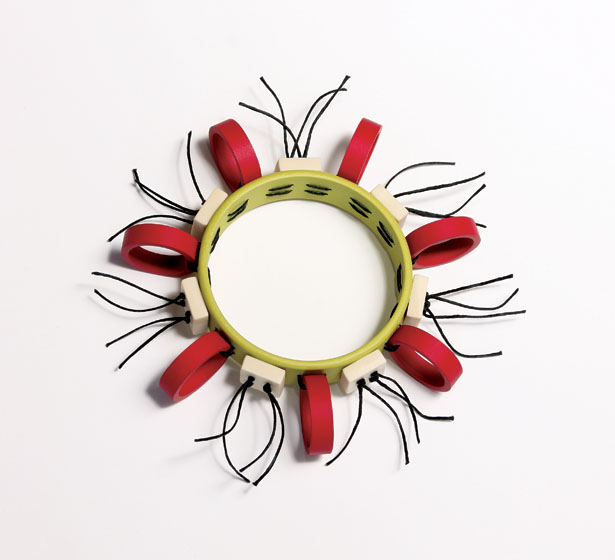
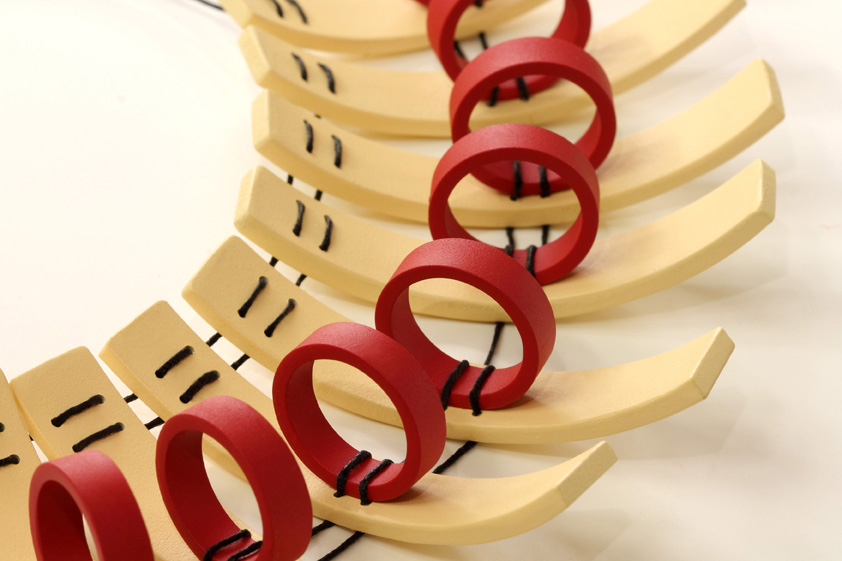
Suburban Tribal 3, bangle. Repurposed plastic conduit & pipe, paint, thread

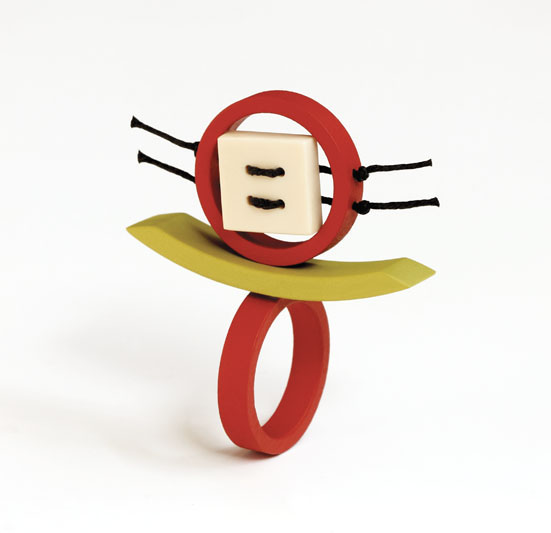
With the Suburban Tribal serie, I associate life in Australian suburbs with one in a tribal society. In this context, jewellery is worn for rituals and to honour deities as well as for beautification and adornment. In our suburban society, we have placed the house and the car on an altar and we worship them in pagan rituals. In traditional tribal society, jewellery is usually made with humble materials that are easily available. This is the case of the discarded plastic pipes and conduits from building sites that I repurposed, they are not precious materials. This serie is part of a body of work I named A Renovator’s Dream – a pun on the loss of the meaning of the ancient indigenous Dreaming in contemporary Australia.

Suburban Tribal 4, ring. Repurposed plastic pipe & conduit, paint, acrylic, thread. © Blandine Hallé 2015

Avec la série ‘Tribu de Banlieue’, j’associe la vie dans les banlieues australiennes à celle d’une société tribale. Dans ce contexte, les bijoux sont portés pour des rituels et pour honorer des dieux, ainsi que pour la décoration et la beauté. Dans nos sociétés banlieusardes nous avons placé la maison et la voiture sur un autel et nous les vénérons dans des rites païens. Dans les sociétés tribales traditionnelles, les bijoux sont en général faits de matériaux humbles qui sont facilement disponible. C’est le cas ici pour les tuyaux et conduits que j’ai recyclés, ce ne sont pas des matériaux précieux. Cette série fait partie d’un ensemble de travail que j’ai appelé ‘Un Rêve de Rénovateur’ – un jeu de mot sur la perte, dans la société australienne contemporaine, du sens originel du Rêve aborigène.

pendant with red plastic circles and white acrylic squares threaded together
Suburban Tribal 2, pendant. Repurposed conduit, acrylic, paint, thread. © Blandine Hallé 2015


A Renovator’s Dream & the alchemy of repurposing

“Here stands the mean, uncomely stone,
Tis very cheap in price!
The more it is despised by fools,
The more loved by the wise. ”                                                                                              Arnaldus de Villanova, 13th century alchemist (1)

Oozing charm - closeup1
Oozing charm, close-up. © Blandine Hallé 2015
pendant, recycled timber & black plastic tubing, distressed paint
Oozing charm, recycled timber and plastic, paint, linen thread. © Blandine Hallé 2015

I find the activity of repurposing utterly exciting and satisfying. Somehow the verb ‘ to repurpose’ is more accurate than ‘to recycle’ in describing what I’m doing by creating jewellery out of junk: it  gives more the idea of an intent, a purpose. It’s not just avoiding the waste of material through the act of recycling, it is to adapt it for use in a different purpose.

There is something magical in the process of transforming a piece of discarded material into a piece of adornment. It feels like an alchemy, which is usually known as the ability to transform base metals into noble metals (gold or silver).

Making something beautiful out of scraps, of bits and pieces that I have collected, not only gives me pleasure during the process of creation and when seeing the final result, but also it is very empowering and structuring. As I create an object on the outside, I create myself from the inside. It helps me define who I am and what I do. I see beyond the junk, I visualise in my mind shapes and form. By making this vision or this dream real, I am projecting out something from within. Making conscious the unconscious.

It was through understanding the significance of alchemical symbolism that Jung came to formulate his central concept of individuation” says Maureen B. Roberts, Ph.D (2). She continues: “In the alchemical search for the Philosophers’ Stone Jung saw a direct parallel to the quest for the divine inner centre of the self. As base metals are gradually transmuted into gold, the ultimate unity and perfection, so unconscious processes manifesting themselves as archetypal images and symbols are transformed into the psychological equivalent of gold or the Stone, the undivided self. Thus the symbolism of the alchemical process represents a centralising and unifying instinct which culminates in the production of the self as a new centre of totality” (3)

Looking at what I have made, as if looking in a mirror, I see who I am.

pendant, recycled plastic orange rings and wooden slates threaded together
subdivide and prosper, plastic, wood, linen thread. © Blandine Hallé 2015

1. C.G. Jung, Memories, Dreams, Reflections. Article selection by S. Parker, PhD. Accessed 17/06/2015 http://jungcurrents.com/alchemy

2. M. B. Roberts, Beautiful Circuiting: The Alchemical Imagination in English Romantism, Text from: The Diamond Path: Individuation as Soul-making in the Works of John Keats, 1997. Accessed 17/06/2015 http://www.jungcircle.com/beautiful.html 

3. C. G. Jung, Psychology and Alchemy, trans. R. F. C. Hull, 2nd ed. (Princeton, NJ: Princeton UP, 1970) 115. Accessed 17/06/2015 http://www.jungcircle.com/beautiful.html

“Ici se tient la pierre mauvaise et laide

Qui vaut très peu en prix

Plus elle est méprisée par les idiots

Plus elle est aimée par les sages »

Arnaldus de Villanova, alchimiste du 13eme siècle (1)

Je trouve l’activité de réutilisation et de transformation passionnante et satisfaisante. Le mot ‘recycler’ n’est pas tout à fait assez précis pour décrire ce que je fais en prenant un vieux matériel et en le transformant en un bijou. En réutilisant et en transformant, il y a l’idée d’une intention déterminée. Il y a quelque chose de magique dans ce processus, une sorte d’alchimie, qui est habituellement connue comme la capacité de transformer les métaux de base en métaux nobles comme l’or et l’argent.

Faire quelque chose de beau à partir de déchets, de trucs ramassés ici et là, me procure du plaisir non seulement pendant l’acte de création et une fois terminé en voyant le résultat final, mais je trouve également que cette activité est très stimulante et structurante. Alors que je crée un objet à l’extérieur, je me crée également à l’intérieur. Cela m’aide à définir qui je suis et ce que je fais. Je vois au-delà du truc que j’ai ramassé, je vois dans mon esprit des lignes et des formes. En rendant cette vision ou ce rêve réel, je projette à l’extérieur quelque chose de l’intérieur de moi. Je rends conscient l’inconscient.

« C’était par la compréhension de la signification du symbolisme de l’alchimie que Carl Jung en est venu à formuler son concept central d’individualisation » dit M. Roberts (2). Elle continue : « dans la recherche alchimique de la pierre philosophale, Jung a vu un parallèle direct avec la quête du centre divin intérieur du moi. Alors que les métaux de base sont graduellement transformés en or, l’union ultime et parfaite, de la même manière les processus inconscients qui se manifestent sous forme d’images archétypes et de symboles sont transformés dans l’équivalent psychologique de l’or ou de la pierre philosophale, le soi non divisé. Donc le symbolisme du processus alchimique représente un instinct unifiant et centralisant qui culmine avec la production du soi comme nouveau centre de totalité » (3)

En regardant ce que j’ai fait, comme en regardant dans un miroir, je vois qui je suis.

A Renovator’s Dream in progress

Continuing on my series  A Renovator’s Dream – repurposing discarded materials – to be presented at the exhibition In Transit in Sydney at Depot II Gallery from 7 to 17 July (invitation coming…)

a renovator's dream in progress

Je continue à préparer ma série “Un Rêve de Rénovateur » – en recyclant des matériaux qui ont été jetés – et qui sera présentée à l’exposition En Transit à Sydney à la Galerie Depot II du 7 au 17 juillet prochain

In memoriam, Rosemary

In honour of my dear friend Rosemary, I will be wearing this necklace tomorrow at her funeral.

En l’honneur de ma chère amie Rosemary, je porterai ce collier demain à ses obsèques.

In memoriam, Rosie 1

Her obituary reads: “her talent, intelligence, humour, integrity and loyalty has enriched the lives of family, friends, fellow musicians, colleagues and patients. Her life was a brilliant one.”

Sa nécrologie dit que : « son talent, son intelligence, son humour, son intégrité et sa loyauté a enrichi la vie de sa famille, ses amis, ses confrères musiciens, ses collègues et ses patients. Sa vie a été brillante »

She was fully in my heart and mind this last week as she inspired me in my studio, upcycling trashed plastic pipes into necklaces.

Elle était très présente dans mon cœur et mon esprit cette semaine passée pendant qu’elle m’inspirait dans mon atelier a “upcycling” des tuyaux de plastiques jetes en colliers.

In memoriam, Rosie 2

With much love.

drift line

These two artworks speak of the making of my new identity as a French woman migrant in Australia and emerging artist.

They show two levels of appropriation and interpretation:

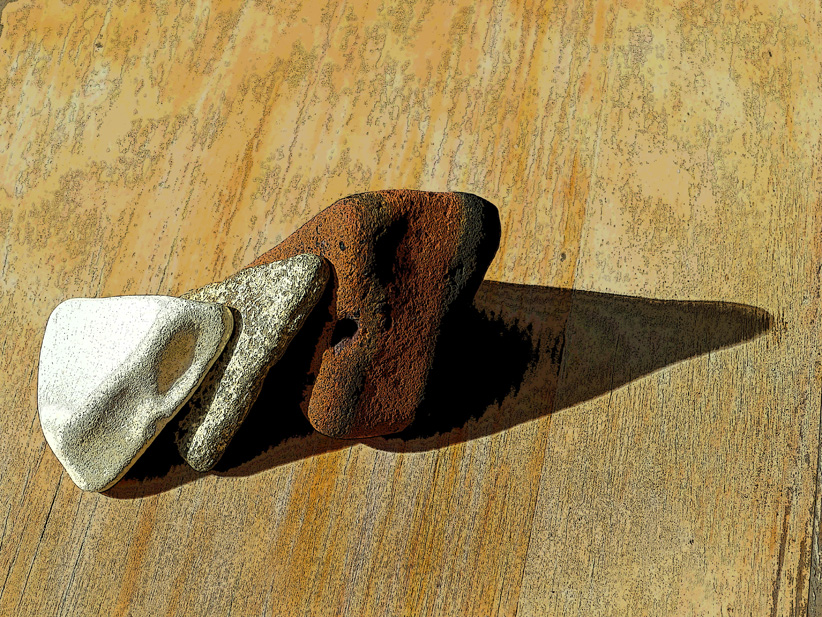
Firstly, I assembled shards found on the beach, remnants of earlier European settlement. I staged these found objects as one would of living characters; I enjoyed the play of their relationships.

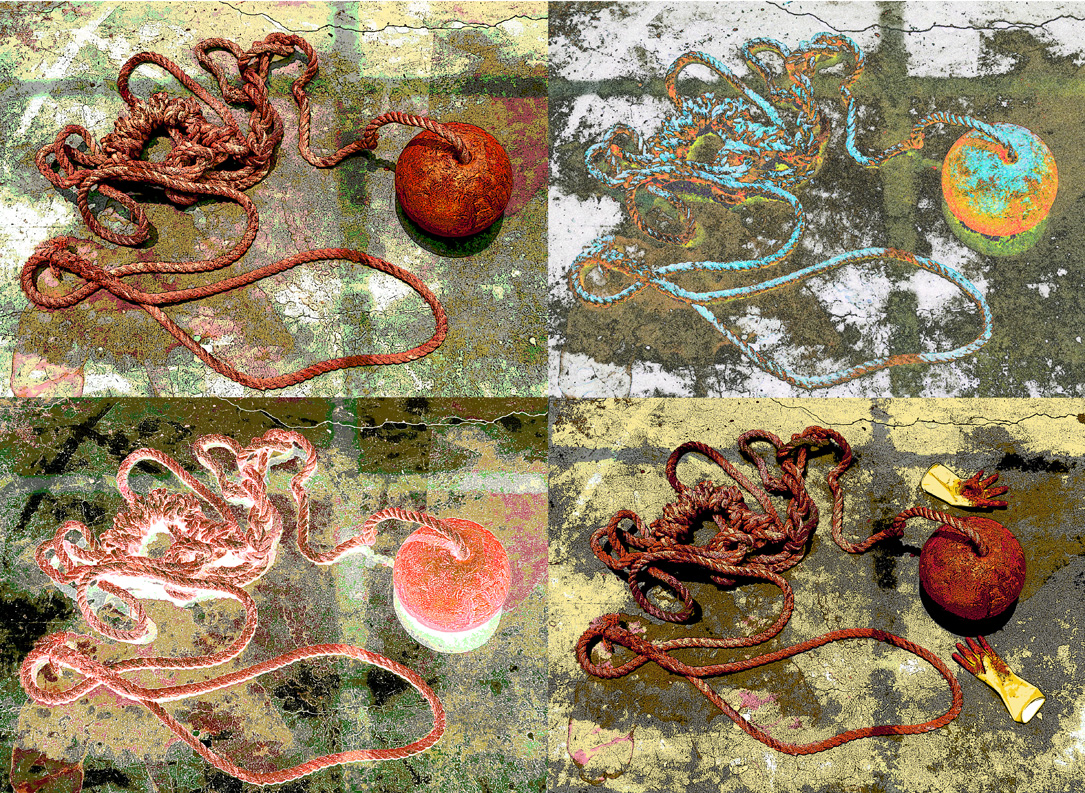
drift line 4
drift line 4 – © Blandine Halle 2014

During that period of assemblage, I wrote about my emotions.

In a second phase I photographed my sculpture and digitally edited it. By including my writing into the image I put myself into the landscape. I created a sense of belonging.

drift line 5
drift line 5 – © Blandine Hallé 2014

rubble mirror

rubble mirror 3 © Blandine Hallé
rubble mirror 3
© Blandine Hallé

I pick up a piece of rubble on the beach, I pick up myself

What do I make of it?  What do I make of me?

Discarded, junk, rubbish that no one cares about, on this deserted beach

What do I see?

I see patina, cracks and lines left by time, tensions, and pulls in different directions

I see roughness and smoothness together in contrasting beauty

I see character that stands out amongst uniformity

I see potential of something more, once associated with others

Shall I leave the rubble there, to be taken away by the ocean?

Again

Washed away, drowned

The water slowly making materiality dissolves

Opening cracks like open wounds

Slowly bringing it back to sand to disappear in the ground

Or shall I bring it home? Safe inside

On the table, shall I give it company or leave it alone?

It has a life of its own and spontaneously finds its place

A dialogue opens up with who is already sitting there

Contrasting lines, complementary textures, shades of colours

The play is exquisite and all-consuming

Pleasure and delight

That’s what a piece of rubble picked up on the beach gives me.

I create therefore I am

umbilicum cordinus
umbilicum cordinus – © Blandine Hallé 2013

Showing your work as an artist – especially emerging as I am – involves a certain degree of risk. Part of the process of becoming an artist is getting used to show your work, and getting used to receiving feedback, whatever it is going to be, including silence. We would all love to receive only praises and compliments. Like the child that runs to her mother to show the drawing that she just made. She wants to hear her mummy say ‘that’s beautiful darling, do another one’. But hey, not everyone in the audience is your mummy and we have to live in peace with ourselves and our art hearing things like ‘it’s nice’ or ‘it’s different’.

As American painter Franz Kline put it: “The real thing about creating is to have the capacity to be embarrassed.” I recently discovered that saying and I love it. My experience is that being a creative artist resides in my ability to expose myself, vulnerable, with my doubts and anxiety, and to keep to doing it. “Just DO!” as Sol LeWitt brilliantly wrote to his young artist friend Eva Hesse.

Descartes is famous for his saying ‘I think, therefore I am’. With all due respect for the French philosopher, from whose culture I come from, thinking is just not enough to make me who I am. My thoughts go around in circle, in some sterile, repetitive motion, if they are not expressed in some way. I need to say something, or do something with that thought in order to feel that this idea takes form in a material way.  Speaking is the primordial way for a human being to express one’s existence; it is a baby’s first cry. Speech is a form of creation. To let the word say what one feels, what one thinks. Making art is another form of creation, through matter, colour, and form. It is a way of saying ‘here I am, this form, this shape, these colours, this is me’. I want to share it with you and hear how it makes you feel.

I’m not all rational, logical, and Cartesian. I am emotional, impulsive, and intuitive; especially when it comes to creating something. First comes out the emotion, the intuition. Second comes out the analytical, rational mind.

Creating is a self-referral process. As the Bhagavad-Gita (IX.8) says ‘Curving back on my own Nature (my Self), I create again and again’. For this creative process to happen, it needs to take on a direction, to flow out and take form. There are constantly three elements interplaying with each other – the creator, the process of creation and the object being created – yet at all time there is an experience of wholeness and oneness.

Julia Cameron has warned us in The Artist’s Way of the danger of showing ones’ work at a too early stage, before one has reached a safe degree of confidence in one’s creation. She says that “creativity flourishes when we have a sense of safety and self-acceptance.” (p42) There are saboteurs of art out there, often blocked artists themselves, who – consciously or unconsciously – will stab you with a sharp line. But once you feel satisfied with the work done, once you feel you have achieved what you wanted to say, then you can expose yourself – in all meaning of the word. Everyone is entitled to their own opinions and you can now hear them all. It won’t stop you saying what you wanted to say, because you’ve already spoken. You’ve already created that piece of something that was part of you, itching inside, that you’ve pulled out, and hung on the wall for everyone to see.